
Virgin Media O2 puts O2 Satellite to the test on a drizzly Welsh mountainside
Virgin Media O2 has demonstrated its Starlink-powered O2 Satellite service to analysts and reporters in Snowdonia, showing texts and an internet voice call beamed straight to an ordinary smartphone from 350km above the Welsh hills.
Virgin Media O2 (VMO2) has demonstrated the satellite backup behind its O2 Satellite service to a group of analysts and reporters in Snowdonia, in the first hands-on press outing for a service that launched earlier this year, according to Light Reading, whose international editor Iain Morris joined the trek on 19 October.
The service, which follows an agreement VMO2 struck with Starlink a year ago, uses direct-to-device — or direct-to-cellular — technology to beam a signal to an ordinary smartphone straight from a Starlink satellite, rather than from an Earth-bound mast. Those satellites orbit at an altitude of about 350km and travel at around 17,500mph. For £3 a month, any VMO2 customer with a modern smartphone can switch to O2 Satellite when they are beyond the reach of a tower.
The “highs and lows” of the demo were apparent from the outset. On a blustery, drizzly, mist-filled day in Caernarfon, the team’s initial challenge was simply finding a not-spot: rival BT-owned EE’s terrestrial service was largely unavailable, but VMO2’s own signal stubbornly refused to vanish, and default handset settings block the satellite option while terrestrial coverage remains. A suitable gap was eventually found after a mud-squelching hike to Aber Falls, where VMO2’s Rob Joyce, the operator’s director of mobile access engineering, established satellite connectivity — confirmed on the device screen by the letters “SAT” appearing where “4G” or “5G” would normally show. Texts were sent and an internet-based voice call was made.
The demo also laid bare the service’s current limits. Only around 650 Starlink satellites today support direct-to-device connectivity, Joyce said, and orbital paths meant there was not always a satellite directly overhead in north Wales, leading to gaps in coverage. Starlink is for now restricted to basic data services: text messages and internet-based voice calls work, but there is no native voice calling and video streaming would be ambitious. “It’s a pure data service,” Joyce said. “It’s there for reassurance of coverage beyond the current cellular footprint.”
To support O2 Satellite, VMO2 is sharing a 5MHz sliver of spectrum in the 1800MHz band between cellular and satellite, delivering about 4 Mbit/s of capacity per 50km-diameter spot beam. The satellite layer lifts VMO2’s landmass coverage from 89% to 95% — six percentage points equivalent to about two-thirds of Wales, and corroborated at the service’s February switch-on as a UK-first partnership with SpaceX following Ofcom’s first UK licence for satellite-to-smartphone services, according to Computer Weekly.
Joyce was adamant satellite will never fully replace cellular — “If you’re 350km away, and you’re coming through tile roofs, aluminium reflective foil and then three stories, there is no way you’re going to get a signal indoors” — but said VMO2 might avoid building new rural sites and rely on Starlink instead. The next generation of Starlink satellites, growing the direct-to-device constellation towards 15,000 spacecraft, promises “a lot more bandwidth”: more and narrower 25km spot beams that could one day support streaming and native voice calls from the hillsides.
“It doesn’t do native voice calling yet,” Joyce said. “Is Elon going to challenge the cellular operators? No, he can’t.” After his first successful test of the service last November, he had messaged VMO2 chief technology officer Jeanie York: “It’s one small text for man, it’s one giant leap for the O2 network.”
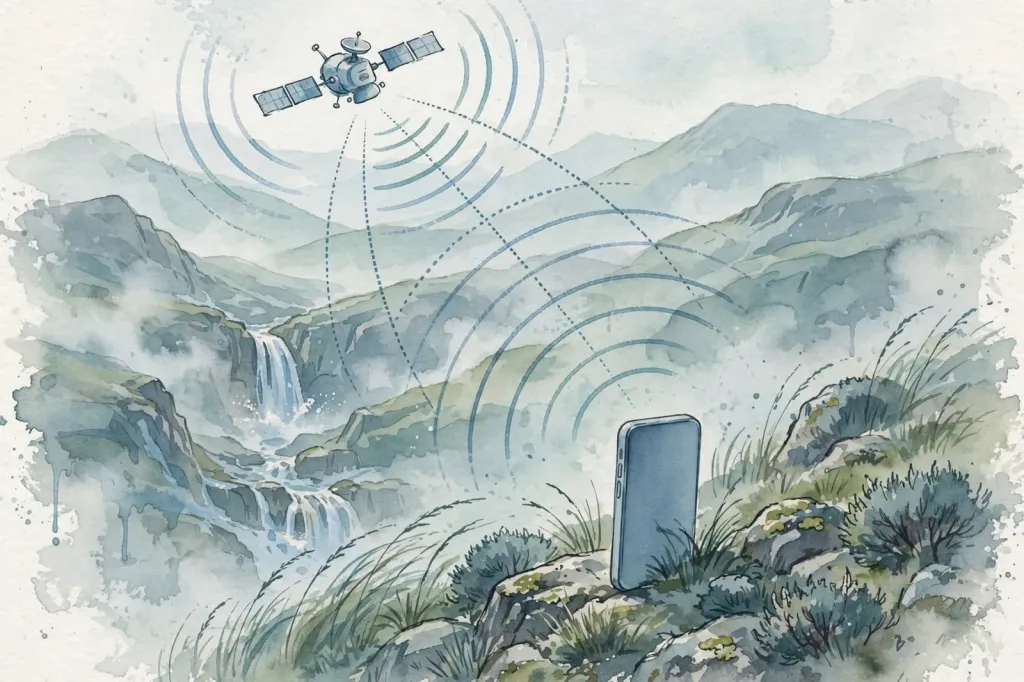
Illustration: AI-generated watercolour editorial illustration for this article.
Sources: Light Reading — “Virgin Media O2 feels highs and lows of Starlink in Wales” (https://www.lightreading.com/satellite/virgin-media-o2-feels-highs-and-lows-of-starlink-in-wales); Computer Weekly — “UK direct-to-device satellite connectivity takes off with Virgin Media O2” (https://www.computerweekly.com/news/366639343/UK-direct-to-device-satellite-connectivity-takes-off-with-Virgin-Media-O2); DataCenterDynamics — “Virgin Media O2 to use Starlink satellites to boost connectivity in remote parts of UK” (https://www.datacenterdynamics.com/en/news/virgin-media-o2-to-use-starlink-satellites-to-boost-connectivity-in-remote-parts-of-uk/).
More on this topic: all Satellite Internet stories