
HPE's Spaceborne Computer-4 to run first AI workloads and HPC benchmarks on the Moon
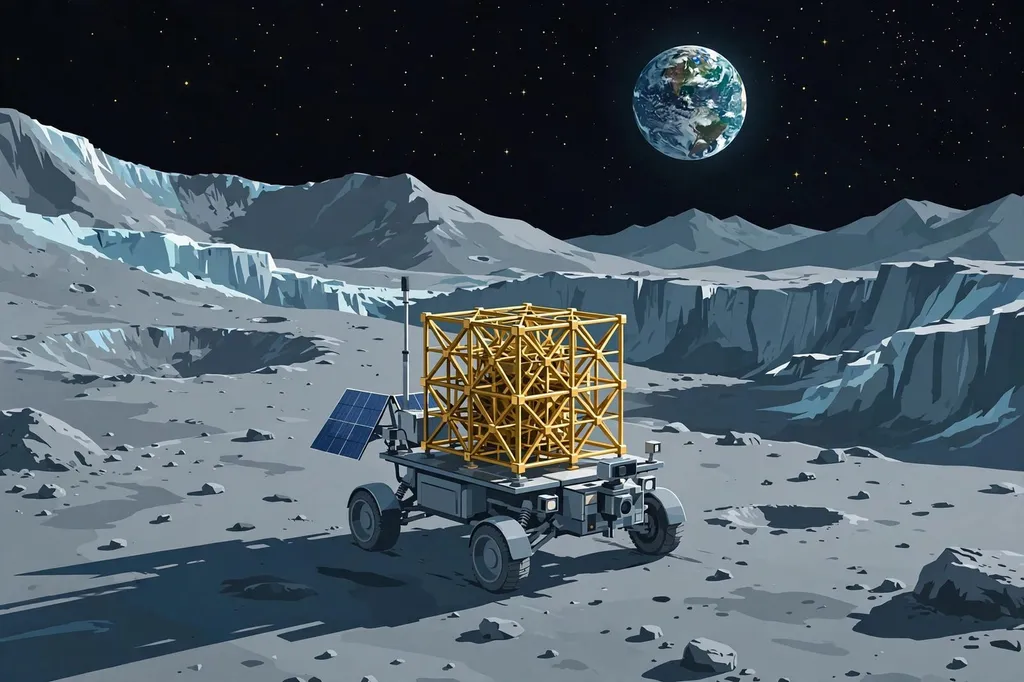
HPE's Spaceborne Computer-4 will ride aboard Astrolab's FLIP rover to the lunar south pole, running AI workloads and what HPE says are the first high-performance computing benchmarks on the Moon's surface.
HPE has announced Spaceborne Computer-4, a compute module that plans to run AI workloads and — the company says — the first high-performance computing (HPC) benchmarks on the surface of the Moon.
Unveiled in Houston on 20 October 2026, the module will ride aboard Astrolab’s FLIP rover on a Moon Base programme mission (HPE). The mission is intended to launch in late 2026 as part of NASA’s Commercial Lunar Payload Services (CLPS) initiative, with Voyager Technologies’ Griffin-1 lander touching down near the lunar south pole.
Planned tests include LLM retrieval-augmented generation, vision inference, LiDAR mapping and navigation data, and an AI services container. The fanless module pairs a low-power CPU and GPU with KIOXIA flash storage and a space radiator instead of a heatsink — the airless Moon cannot cool one (ServeTheHome).
NASA will run its FLUID experiment on board, coordinating three AI models trained on Earth, the Moon and ISS data, plus a tuned LLM for interpreting onboard documents. Deloitte’s Silent Shield system will provide near-real-time cyber intrusion detection.
“With HPE Spaceborne Computer-4, we are bringing AI and high performance computing to the lunar edge, helping the acceleration of scientific discovery and building the infrastructure for the next era of exploration,” said Scott Wiest, vice president, fellow and global sales chief technologist at HPE.
“The Moon presents a challenging environment for advanced computing, and we’re pleased to provide HPE with an opportunity to demonstrate its technology on the lunar surface,” said Jaret Matthews, founder and CEO of Astrolab.
More on this topic: all Science stories